

Last reviewed: September 2026. Market figures, utility details, and school information change — verify anything time-sensitive before you rely on it.
🎧 Prefer to listen? Here's a short audio overview of this guide.
Moving to Bryan, Ohio: The Short Answer
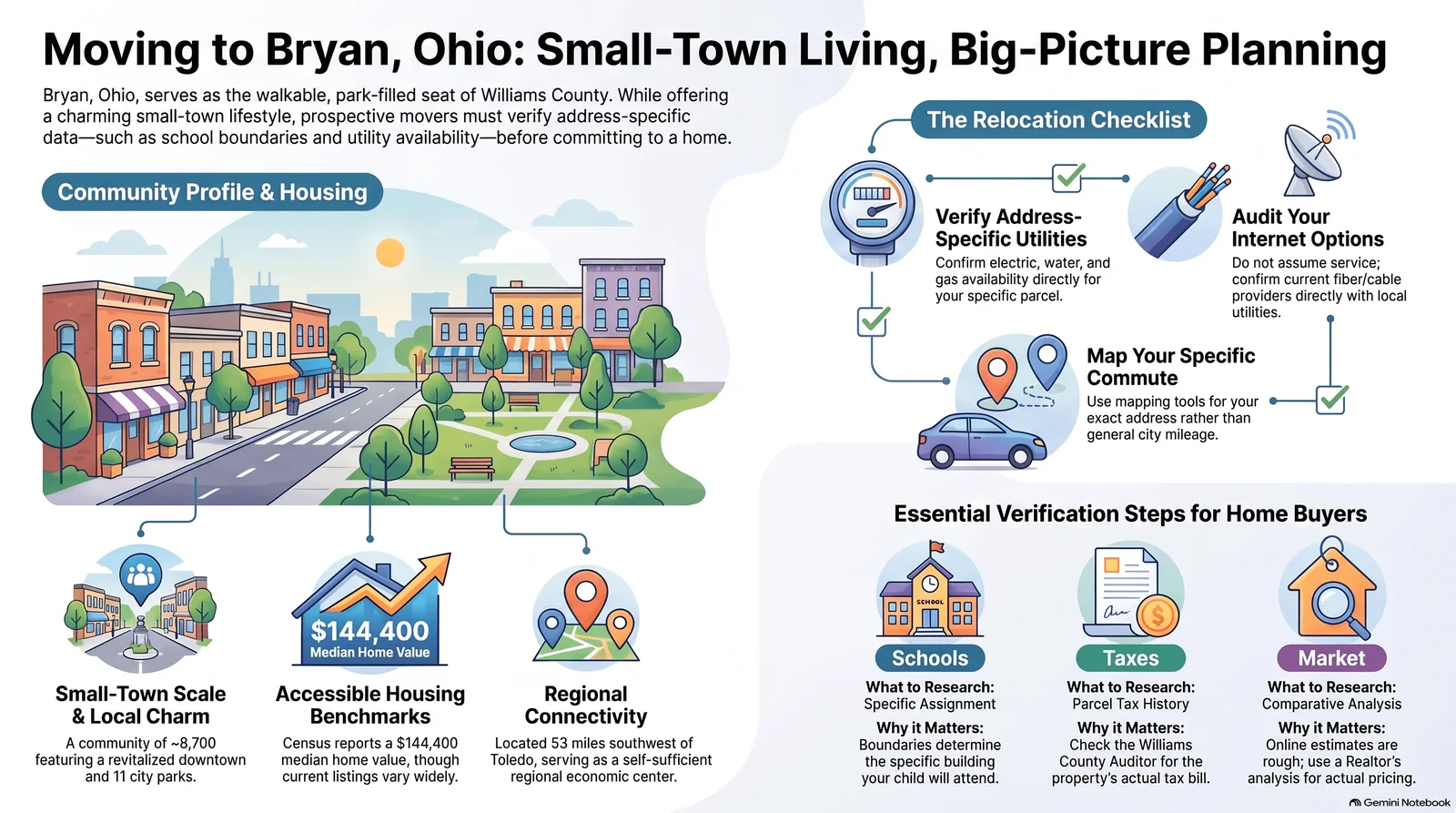
Bryan is the county seat of Williams County, in Ohio’s northwestern corner (Wikipedia; Ballotpedia). The city describes itself as combining small-town scale with everyday conveniences: a revitalized downtown shopping and entertainment district, an extensive park system, and local schools (City of Bryan).
Whether that adds up to the right move for your household depends on things no article can answer for you — your job location, your school priorities, your budget, and what you actually want daily life to look like. This guide lays out what’s verifiable about Bryan today, and exactly what you should check yourself before you commit to a specific address.
Where Is Bryan, Ohio?
Bryan sits in Williams County in the far northwest corner of Ohio, roughly 53 miles southwest of Toledo (Wikipedia). It’s the county seat, meaning county government offices — including the Williams County Auditor, who handles property records and tax appraisals — are based here (Williams County Auditor).
If you’re relocating from a larger metro area, it helps to think of Bryan less as a suburb of anywhere and more as its own small city with its own economy, schools, and services, situated within reach of Toledo and nearby Indiana communities. Confirm your own commute distance and route using a current mapping tool for your specific starting point — mileage from one direction of the county isn’t the same as another.
What Daily Life in Bryan Is Like
The City of Bryan points to a walkable, revitalized downtown, community events, and a park system as part of what daily life looks like here (Explore Bryan). As of the 2020 Census, Bryan had a population of 8,729, with more recent Census Bureau estimates in a similar range (Census Reporter).
At that size, day-to-day life tends to mean shorter drives to errands, a smaller school system, and a downtown you can reasonably get to know. That’s a genuinely different pace than a large metro suburb — for some households that’s the draw, for others it’s a real adjustment. There’s no substitute for visiting in person, ideally on a weekday and a weekend, before deciding it’s the right fit.
Housing Options in Bryan
Housing in Bryan ranges from older homes near downtown to more recently built homes on the edges of town, along with some multi-family and rural-adjacent properties as you move toward the township line. Rather than naming specific “neighborhoods” — Bryan’s zoning map identifies zoning districts, not consumer-facing neighborhood names — it’s more accurate to think in categories:
- Downtown and near-downtown Bryan
- Established residential streets
- Areas near parks, schools, and everyday amenities
- Edge-of-town, lower-density, or larger-lot options
Which of these fits you depends on the specific street, lot, home condition, zoning, utility access, school assignment, and your own commute and lifestyle preferences — not a general label. If you want to see how a particular street or area currently looks in terms of available homes, Dave can walk you through what’s on the market in your target area.
What It Costs to Live in Bryan
Cost of living is where it matters most to separate different kinds of numbers, because they’re not measuring the same thing.
Census housing benchmarks (2020–2024 American Community Survey estimates): the median value of owner-occupied housing units in Bryan was $144,400, and median selected monthly owner costs for homes with a mortgage were $1,103 (U.S. Census Bureau QuickFacts). These are multi-year averages across all owner-occupied homes, not a snapshot of what’s for sale today.
Current market indicators (each measuring something different):
- Zillow’s Bryan market page reported an average home value around $195,021 and a median list price around $243,600, in data dated April 30, 2026 (Zillow Home Values)
- Redfin reported a median sale price of roughly $189,000 in its most recent reported month, and roughly $192,000 averaged over the three months ending August 2026 (Redfin Housing Market)
- Realtor.com’s search results showed 58 active homes for sale with a $139,450 median listing price at the time retrieved (Realtor.com)
Notice these three numbers don’t agree — and they shouldn’t be expected to. Zillow’s figures include an estimated “home value” model alongside list prices; Redfin’s are sale prices; Realtor.com’s are active listing prices from a specific search. Different measurement, different time window, different sample of homes. None of them is “the” Bryan home price, and none should be treated as what your specific home is worth or what you’d pay for a specific property. For that, you want a Realtor’s comparative market analysis — which looks at recent comparable sales, active competition, and your specific property — or a licensed appraisal if your lender requires one.
Property taxes are another area where a general percentage isn’t useful to you. Look up the actual parcel, valuation history, and current tax bill through the Williams County Auditor’s real estate search or pay/verify taxes directly before budgeting around an assumed number.
Utilities, Internet, and Everyday Services
Electric, water, and communications utilities in Bryan are handled by Bryan Municipal Utilities (BMU), a customer-owned utility (City of Bryan Utilities Billing). City site-selection materials describe municipal service availability in served areas as including electric, water, communications, sanitary sewer, and storm sewer, with natural gas available through Ohio Gas Company (City of Bryan Site Selection).
That said, “available in Bryan” is not the same as “available at your specific address” — service area boundaries, connection requirements, and billing all need to be confirmed for the exact property you’re considering. The utility billing office is in the Don North Municipal Building, 1399 E. High Street, Bryan, OH 43506, open Monday through Friday, 8:30 a.m. to 4:30 p.m.
Internet is worth double-checking specifically. BMU has previously described a fiber/cable internet offering, but at least one 2025 report indicates BMU discontinued internet service as of December 9, 2024 (BMU; Broadband Expanded). Rather than assume either way, confirm current internet provider options directly with BMU and by checking availability at the specific address before you sign anything that depends on it.
Schools and Education Options
Bryan City Schools operates the district, with a district office at 1350 W. Fountain Grove Drive (Bryan City Schools). Bryan Elementary serves grades PK–5 at 1301 Center Street, and Bryan Middle/High School serves grades 6–12 at 1000 W. Fountain Grove Drive (Bryan Elementary; Bryan Middle/High School). The district accepts new students throughout the school year, with enrollment requirements and registration posted on its site (Registration).
St. Patrick Catholic School in Bryan is also identified by the city as a K–8 option (City of Bryan).
This guide won’t rank schools or use terms like “top-rated” or “best” — those claims require sourced, current data this article doesn’t have, and school quality is genuinely subjective to what a given family needs. What you should verify directly with the district before buying: which school a specific address is assigned to, current enrollment/registration steps, and any boundary or capacity considerations for the school year you’d be enrolling in.
Parks, Downtown, Dining, and Things To Do
The City identifies 11 parks in Bryan, along with a Recreation Park fitness course, an 18-hole disc golf course, and pickleball (Explore Bryan). Nearby Williams County attractions named by the city include the Williams County Fairgrounds, county parks, the Williams County Historical Society, and the Wabash Cannonball Trail.
Downtown Bryan itself is described by the city as a shopping and entertainment district. If proximity to a specific park, trail access, or downtown walkability matters to your decision, check the actual distance from a specific address using a current map — “close to downtown” varies a lot depending on which street you’re on.
Jobs, Commuting, and Regional Access
Bryan functions as its own local economic center as the Williams County seat, with access to the broader Northwest Ohio and northeast Indiana region. If your job is based in Toledo, Fort Wayne, or another regional city, your actual daily commute will depend heavily on which side of Bryan you live on and which route you take — look this up yourself with a current mapping tool using your specific home and work addresses, rather than relying on a general mileage figure for the city as a whole.
Hypothetical example (not a real client, for illustration only): a household relocating to Bryan for a job based in a nearby regional employment center might compare a home closer to downtown Bryan — shorter local errands, closer to schools and parks — against a home on the edge of town with more land, weighing the trade-off between commute time toward their job and the space and price difference of a more rural-adjacent property. The right answer depends entirely on that household’s specific job location, budget, and priorities.
Who May Enjoy Living in Bryan — and Who Should Research Further
People who tend to value a smaller-scale community, a walkable downtown, easy access to parks and outdoor recreation, and a lower pace of daily life often find a lot to like about a city Bryan’s size. People whose priorities center on a large selection of dining and entertainment options within a short drive, a big-city job market immediately at hand, or specific school programs not offered by a district this size may want to research those specific needs carefully before deciding Bryan fits.
Neither of these is a verdict — they’re a starting point for the research you should do yourself: visiting in person, checking your actual commute, confirming school assignment for a specific address, and pricing out actual homes rather than averages.
A Practical Moving-to-Bryan Checklist
| Topic | What to research | Why it matters before moving |
|---|---|---|
| Housing | Actual listings and recent comparable sales for your target area and price range | Market averages (Zillow, Redfin, Realtor.com) measure different things and won’t tell you what a specific home costs |
| Utility availability | Confirm electric, water, sewer, and gas service with BMU and Ohio Gas Company for the exact address | “Available in Bryan” doesn’t guarantee availability at every specific parcel |
| Internet | Confirm current provider options directly with BMU for the address | Reported service changes mean you shouldn’t assume continuity |
| Schools | Confirm school assignment and current enrollment steps with Bryan City Schools for the exact address | Boundaries and capacity can affect which building your child attends |
| Commute | Map your actual route and time from the specific home address to your workplace | City-wide mileage doesn’t reflect your specific commute |
| Medical care | Identify your preferred providers/facilities and confirm they serve the area you’re considering | Access to care varies by specialty and location |
| Taxes and insurance | Look up the specific parcel’s tax history with the Williams County Auditor; get insurance quotes for the specific property | Generic percentages don’t reflect your actual bill |
| Neighborhood fit | Visit the specific street at different times of day; talk to a local Realtor about the area | “Downtown” versus “edge of town” trade-offs are personal, not universal |
Once you have a target area in mind, use the moving cost calculator to get a rough budget for the move itself — movers, storage, temporary housing — separate from what the home purchase will cost.
Talk With a Local Bryan Realtor
If you’re weighing target areas, current homes on the market, the practical steps of buying in Ohio, or just trying to figure out your timing, a no-pressure conversation is usually more useful than another spreadsheet of averages. Dave Dempsey is a Realtor and Auctioneer with The Carlin Company Realty & Auctioneers, and works with buyers relocating to Bryan and the surrounding area regularly.
You can also start with a few self-serve tools: browse current homes for sale in the Bryan area, get a ballpark home value estimate (not a substitute for a full comparative market analysis), or see what price range fits your budget with the home affordability calculator before you start touring. Read more about buying a home or selling one if your move involves both. If your move includes land, a farm, or an estate, Dave’s auction services may also be relevant. See all the areas Dave serves across Northwest Ohio, or read more about Dave’s background. Not sure Bryan is even the right part of the state for you? Take the Where Should You Live in Ohio? quiz to compare it against seven other Ohio regions based on your own priorities.
Call or text Dave Dempsey at 419-799-0291 to discuss buying, selling, relocating, or understanding your options in Bryan and Northwest Ohio.
Conclusion
Bryan is a small city with real, verifiable things going for it — a walkable downtown, 11 parks, its own school district, and a municipal utility that’s been running since 1892. None of that tells you whether it’s the right move for your household, and no article honestly can. The market figures above disagree with each other because they measure different things; the utility and internet situation depends on your exact address; school assignment depends on where you actually buy. Treat this guide as the list of questions to go answer, not the final answer itself — and when you’re ready to look at actual homes instead of averages, that’s a conversation, not a spreadsheet.