
Last reviewed: September 2026. Zoning, school assignment, and market conditions change — verify anything time-sensitive directly with the relevant office before relying on it.
Best Neighborhoods in Bryan, Ohio: Start With Your Priorities
If you’re searching for “the best neighborhood in Bryan, Ohio,” the honest answer is that there isn’t one — not because Bryan lacks good places to live, but because “best” is a personal judgment, not a fact. Bryan is a small city, and what matters more than a broad area label is the specific street, lot, and home you’re actually considering.
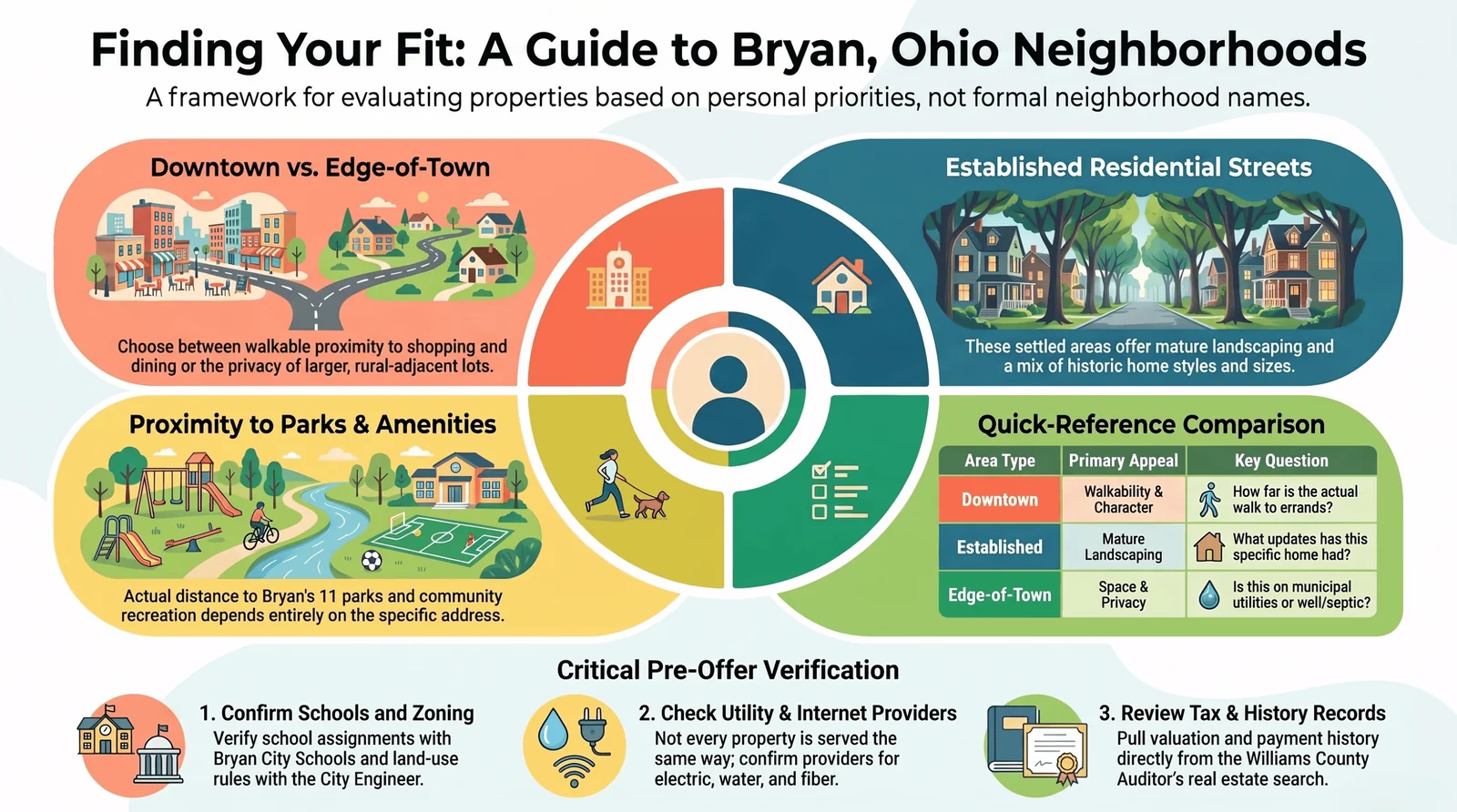
This guide won’t hand you a ranked list or invented neighborhood names. Instead, it walks through four transparent, descriptive categories you can use to compare areas based on what you actually care about — and exactly what to verify before you make an offer on anything.
Why a “Best” Neighborhood Depends on the Buyer
A young professional who wants to walk to downtown coffee shops has different priorities than a family who wants a larger lot and a quiet dead-end street, who has different priorities than a retiree who wants single-floor living close to everyday errands. None of these buyers is wrong, and none of their preferred areas is objectively “best” — they’re optimizing for different things.
Bryan also doesn’t have the kind of formally named, consumer-facing neighborhoods you’d find in a larger city. The City’s zoning map defines zoning districts for planning and regulatory purposes, not marketing-friendly neighborhood names or boundaries (City of Bryan zoning materials). Any “neighborhood” names you see in a listing description or a conversation are informal shorthand, not official designations — worth knowing so you don’t over-rely on a name that doesn’t have a fixed, agreed-upon boundary.
With that in mind, here are four descriptive categories — not official names — to help you think through what you’re actually looking for.
Downtown and Near-Downtown Bryan
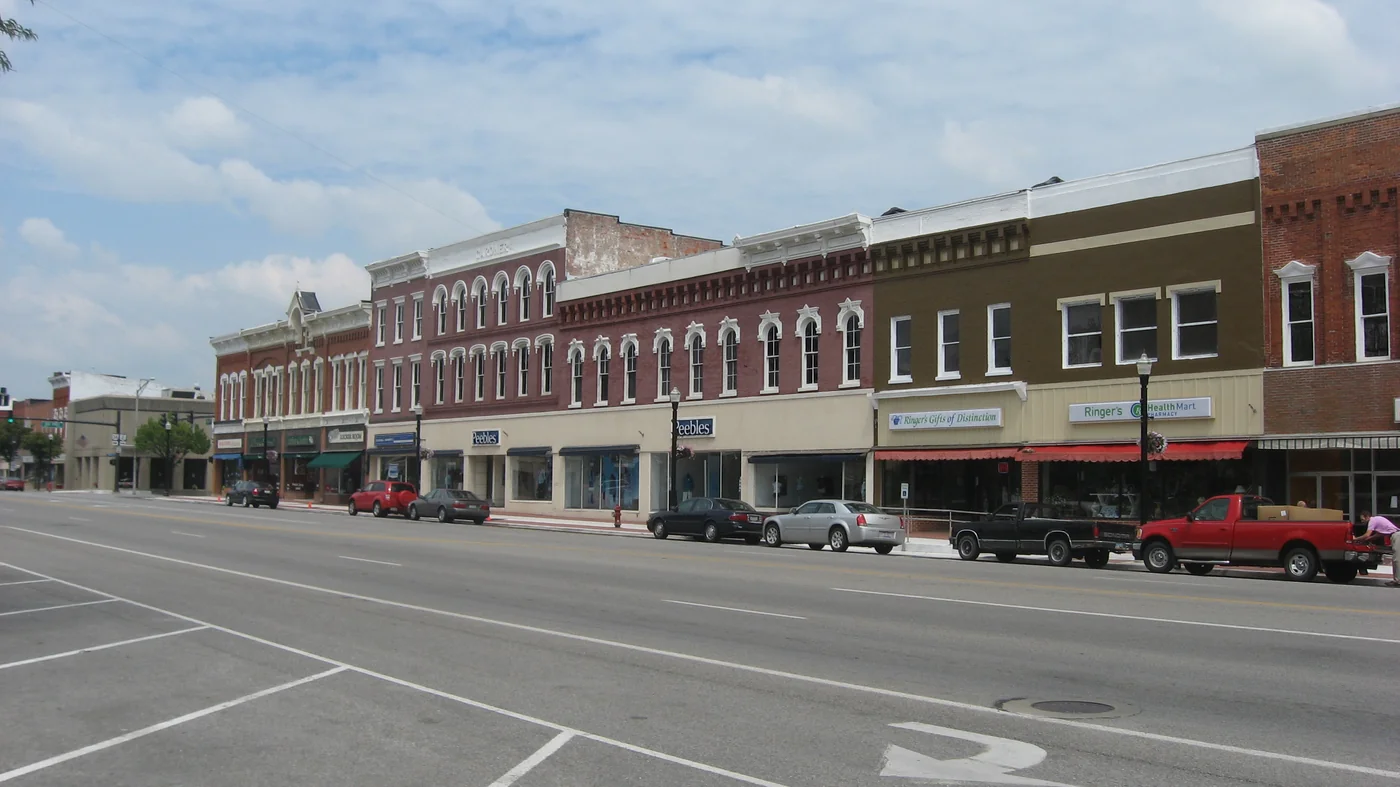
Homes in and near downtown Bryan tend to appeal to buyers who want proximity to the city’s shopping and entertainment district and a shorter drive (or walk, depending on the exact address) to daily errands (City of Bryan — Explore Bryan). Housing stock here tends to run older, since this is generally the original, established part of the city.
What this category does not tell you: the condition of a specific home, its lot size, or its exact walking distance to any particular business. Two homes both described as “near downtown” can be a five-minute walk apart or a fifteen-minute walk apart. Check the actual address on a current map before assuming walkability.
Established Residential Streets
This category covers the bulk of Bryan’s housing stock — streets built out over past decades, generally with a mix of home ages, styles, and lot sizes, neither right downtown nor at the city’s edge. Buyers who prioritize a settled, already-developed street with mature trees and established landscaping often look here.
Because “established” covers a wide range of streets, condition and updates vary significantly from one house to the next, even on the same block. This is exactly the kind of category where the individual home matters far more than the general area — a well-maintained home on an established street can be a better buy than a poorly maintained one in a more sought-after category.
Areas Near Parks, Schools, and Everyday Amenities
Some buyers prioritize proximity to Bryan’s public recreation options — the city identifies 11 parks, a Recreation Park fitness course, an 18-hole disc golf course, and pickleball among its community amenities (City of Bryan — Explore Bryan). These are broader community amenities available to Bryan residents generally, not evidence that any specific home is close to a specific park — actual distance depends entirely on the address.
The same caution applies even more strongly to schools. This guide will not claim any home is “walkable to school,” “in the good school zone,” or otherwise make a school-quality or boundary claim — school assignment is determined by Bryan City Schools based on the specific address, not by general area, and can only be confirmed by contacting the district directly (Bryan City Schools). If school assignment matters to your decision — and for many buyers it does — treat it as a verification step, not an assumption you make from a listing description.
Edge-of-Town and Larger-Lot Possibilities
 Aerial view showing how compact Bryan’s town grid is against the surrounding farmland. Photo: Ken Lund, CC BY-SA 2.0, via Wikimedia Commons.

Toward the edges of Bryan and into unincorporated Williams County, buyers can generally find lower-density housing and larger lots, sometimes bordering agricultural land. This category tends to appeal to buyers who prioritize space, privacy, or specific uses (a large garage, room for animals, a longer driveway) over proximity to downtown.
Properties in this category are more likely to involve well and septic systems instead of municipal water and sewer, and may fall outside Bryan Municipal Utilities’ service area entirely — both are things to confirm for the specific parcel, not assume based on general location. If you’re considering land, acreage, or a property that blurs the line between residential and rural, Dave’s background as both a Realtor and a licensed auctioneer covers exactly that kind of property.
How to Compare Homes Street by Street
Once you’ve identified which general category fits your priorities, the real comparison work happens at the street and home level. Use this table as a starting framework — not a ranking of the categories against each other, since they’re suited to different buyers, not competing for the same “best” title.
| Area type | May appeal to buyers who prioritize | Questions to ask | What to verify |
|---|---|---|---|
| Downtown and near-downtown | Walkability to shopping/dining, shorter errands, older home character | How far is this specific address from downtown on foot? What’s the home’s age and condition? | Exact walking distance via current map; home inspection findings; zoning |
| Established residential streets | A settled, already-developed street; mature landscaping | What updates has this specific home had? How does it compare to others on the block? | Condition of major systems (roof, HVAC, plumbing, electrical); comparable recent sales |
| Near parks, schools, amenities | Proximity to recreation and everyday amenities | What school is this address actually assigned to? How far is the nearest park in practice? | School assignment with Bryan City Schools; actual distance and route to amenities |
| Edge-of-town, larger lots | Space, privacy, larger lot, rural-adjacent feel | Is this on municipal utilities or well/septic? What’s the zoning? | Utility provider and service confirmation; septic/well inspection; zoning with the City Engineer |
Questions to Ask Before Making an Offer
Beyond the area-level questions above, every offer should include due diligence on the specific property:
- Exact school assignment — confirmed directly with Bryan City Schools for the address, not assumed from the area (Bryan City Schools)
- Zoning — confirmed with the City of Bryan’s City Engineer office, since zoning affects what you can do with a property (City Engineer)
- Flood and drainage information — ask the seller and check available flood zone data for the parcel; drainage issues aren’t always visible during a single showing
- Utility providers — confirm electric, water, sewer, and gas providers and service availability for the specific address, since not every property is served the same way (City of Bryan Utilities Billing)
- Internet availability — verify current provider options for the address rather than assuming based on general city information
- Property tax history — pulled directly from the Williams County Auditor’s real estate search, including valuation history and any pending reassessments (Williams County Real Estate Search)
- Condition of major systems — roof age, HVAC, water heater, electrical panel, and plumbing, typically assessed through a professional home inspection
- Lot lines and easements — confirmed through a survey or the county’s property records, especially for larger or edge-of-town lots
- HOA requirements, if applicable — most Bryan properties won’t have one, but if a specific property does, get the governing documents and fee history in writing
- Travel patterns at relevant times — drive or walk the route to work, school, or frequent errands at the time of day you’d actually make that trip, not just whenever you happen to be touring
Tour Bryan Like a Local
Numbers and categories only get you so far. Before deciding on an area, spend time in it the way you’d actually live in it: drive your prospective commute during real rush hour, walk downtown on both a weekday and a Saturday, and visit a park or two at the time of day you’d realistically use them. A street that looks quiet on a Tuesday afternoon showing can feel different on a Friday night, and vice versa.
If you’re relocating from out of the area, consider spending a full day in Bryan before you narrow down a target area — grab a meal downtown, walk a park, and drive by a few streets in each of the categories above during normal daily hours.
Find Your Bryan Home With Dave Dempsey
Tell Dave your price range, preferred home style, lot needs, daily destinations, and timeline. He can help you identify current options that fit your priorities — not a generic “best neighborhood” list, but actual homes and streets that match what you’re looking for. Dave Dempsey is a Realtor and Auctioneer with The Carlin Company Realty & Auctioneers, and works with buyers across all four of the categories above.
Not sure what price range to look in yet? Try the home affordability calculator to see a realistic range based on your income and debts before you start comparing streets.
Start by browsing current homes for sale in the Bryan area, read more about the home-buying process, see everywhere Dave serves across Northwest Ohio, or just reach out directly with what you’re looking for. Still deciding whether Bryan itself is the right part of Ohio for you? Take the Where Should You Live in Ohio? quiz for a broader regional comparison first.
Conclusion
The most useful way to search for a home in Bryan isn’t by area reputation — it’s by matching your own priorities (commute, lot, school assignment, walkability, budget) against the specific streets and homes that are actually available, then verifying the details that matter to you directly with the city, the school district, and the county. A home that’s right for one buyer’s priorities may be entirely wrong for another’s, and that’s fine — the goal isn’t finding the “best” neighborhood, it’s finding your fit.
Call or text Dave Dempsey at 419-799-0291 to discuss buying, selling, relocating, or understanding your options in Bryan and Northwest Ohio.